

Char Ghughumari: Battling Life through Locally Led Climate Action
In Char Ghughumari of Kurigram, life is shaped by the river. The Brahmaputra brings fertile land, fish, crops and livelihoods. Yet the same river can take away homesteads, cropland, schools, markets and community assets within days. For families living on chars, climate risk is not a distant threat; it is part of everyday life.
The Brahmaputra is one of South Asia’s major transboundary river systems. It begins in the Tibetan Plateau of China as the Yarlung Tsangpo, flows through India’s Arunachal Pradesh and Assam as the Brahmaputra, and enters Bangladesh through Kurigram. Inside Bangladesh, it becomes the Jamuna before joining the Ganges-Padma and Meghna river system on its way to the Bay of Bengal. For Bangladesh, the Brahmaputra-Jamuna is a vital freshwater lifeline. It supports agriculture, fisheries, transport, soil fertility and river-based livelihoods. Yet in the chars of Kurigram, this lifeline also brings deep uncertainty. The river creates land through silt, then breaks it through erosion. It forms chars, shifts channels, cuts riverbanks and forces families to rebuild again and again.
Chars (islands of Bangladesh) are among the most climate-vulnerable settlements in Bangladesh. National estimates suggest that char lands cover around 5% of the country’s land area and support about 6.5 million people. In Kurigram, around 250 chars have emerged across the Dharla, Baromasia and Neelkomol riverbeds. These lands create opportunities for farming and livelihoods, while exposing communities to repeated floods, erosion, isolation and limited access to basic services.
Char Ghughumari reflects the daily struggle of life on a riverine char. Located in Shaheber Alga Union of Ulipur, Kurigram, the village is surrounded by the Brahmaputra and depends mainly on river transport. Around 600 households and 2,639 people (54% female) live with repeated floods, erosion and limited access to services. Nearly 90% of families depend on agriculture and livestock, producing maize, groundnut, paddy and foxtail millet. The village has one community clinic, one primary school, one market, one cluster village, one solar electricity station and two solar irrigation pumps. Despite fragile connectivity, low-lying homes and weak WASH facilities, its fertile land and strong farming base offer real potential for climate-resilient livelihoods and locally led adaptation.
In this context, every service point matters. A clinic, a school, a road, a water source or a small transport link is not just infrastructure; it is part of the community’s ability to survive, recover and continue life with dignity. The urgency became painfully visible when the Ghughumari Community Clinic, the village’s only nearby source of primary healthcare, was lost to severe riverbank erosion. The clinic had been providing essential primary health care to the local riverine community.
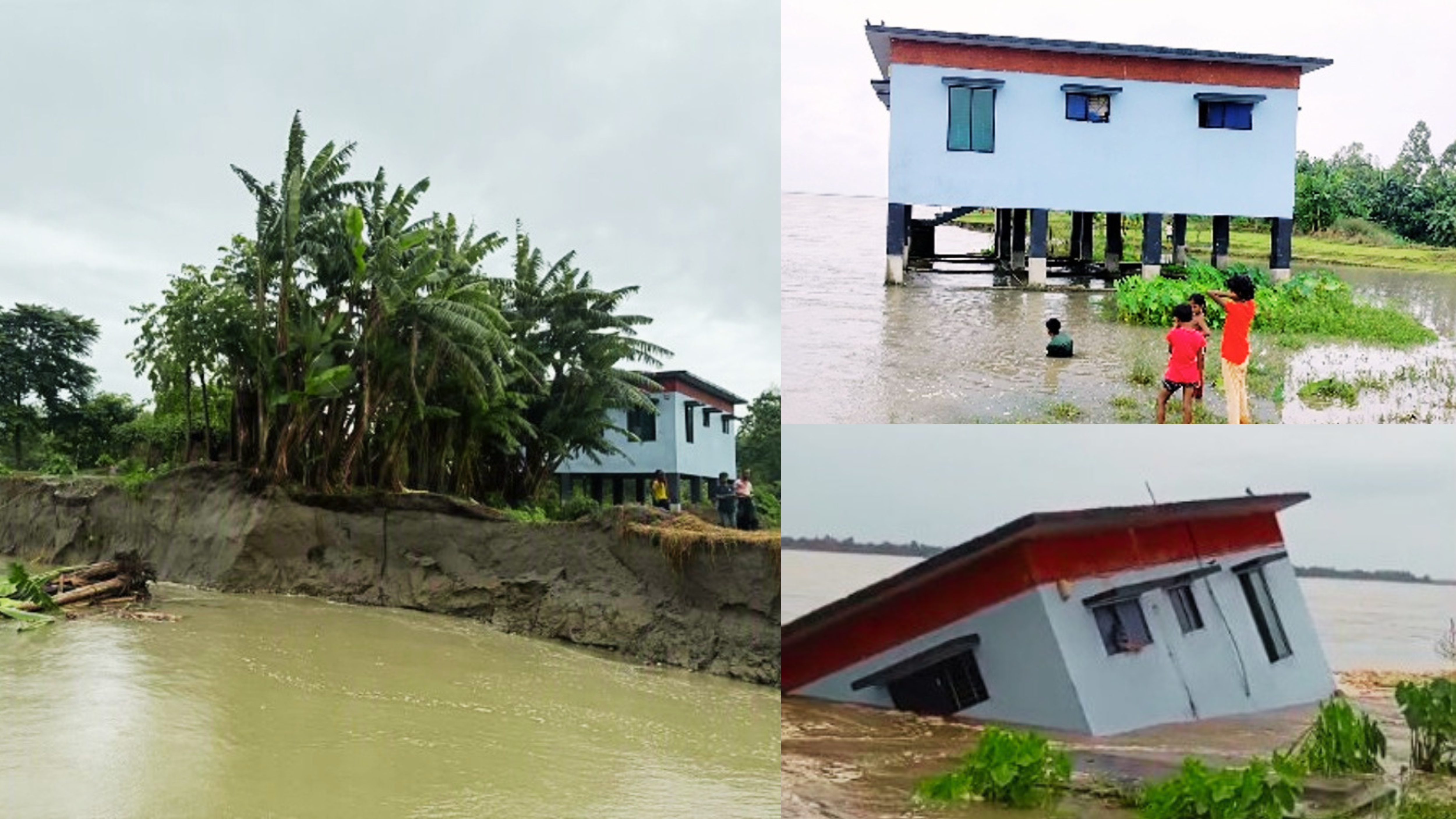
This incident reflects a wider reality for thousands of char communities across Bangladesh. In erosion-prone riverine areas, conventional infrastructure remains highly exposed. Health facilities, schools, WASH points and community assets can disappear as the river changes course. This highlights the need for alternative, climate-resilient service delivery models, including raised, flood-safe, modular or relocatable health facilities that can continue serving communities even when the land itself is unstable.
In Char Ghughumari, adaptation begins with local people. Through the Climate Action at Local Level (CALL) programme, implemented by Swiss Red Cross with the Bangladesh Red Crescent Society and supported by the Embassy of Switzerland in Bangladesh, communities are strengthening preparedness long before floods arrive. The programme combines safer water and sanitation, community preparedness, resilient public infrastructure and livelihood support. Households are raising plinths above flood levels, schools and community facilities are being strengthened, early warning systems are improving, and local disaster management committees are helping families prepare before disasters strike.
JAMUNA’s strength is its integrated and community-centred approach. It connects flood preparedness, WASH, health, livelihoods, community infrastructure and environmental protection into one local resilience pathway. In char areas, where floods contaminate water sources, damage sanitation facilities, interrupt schooling, affect health services and destroy income options, resilience requires joined-up solutions.
These actions help communities protect lives, assets and essential services before, during and after floods. A raised plinth can protect a home. A safe water source can reduce disease risk. A reconstructed school can keep education functioning. An upgraded community centre can support meetings, preparedness activities and emergency coordination. A revitalised community clinic can improve access to timely health care in remote char areas. JAMUNA also links resilience with livelihoods and food security. Through nutrition houses, agri-farm models, skills development, job placement and women’s entrepreneurship, the project supports households to diversify income and strengthen food security. Women are also gaining opportunities through skills training and small enterprises. But training alone is rarely enough. Access to productive assets, start-up support and market are needed for sustainable livelihood.


The project further promotes nature-based and environmentally friendly practices, including reduced use of chemical fertiliser and pesticides, natural resource management and green response campaigns. This is critical in char areas, where livelihoods depend directly on land, water and soil. Climate resilience cannot be built by weakening the natural resources that communities rely on.
Local stakeholders often highlight a difficult reality: significant investments are made in Kurigram, but river erosion can repeatedly destroy infrastructure and development gains. This means investment in char areas must be climate-resilient, risk-informed and locally owned. Roads, schools, clinics, shelters, WASH facilities and livelihood support need to be designed with flood levels, erosion risks, community access and long-term maintenance in mind.
Char Ghughumari reminds us that climate resilience is not built through infrastructure alone. It grows through informed communities, responsive local institutions and investments designed for landscapes that never stand still. As rivers continue to reshape Bangladesh's northern frontier, the people of Char Ghughumari are showing that locally led climate action is not simply an adaptation strategy it is the foundation for living with uncertainty.
True climate resilience in erosion-prone char areas cannot be achieved through household-level adaptation alone; it demands risk-informed, climate-resilient service delivery models that ensure the continuity of health, education, and livelihoods even when physical land disappears. The systematic failure of conventional, static infrastructure—symbolised by washed-away community clinics—underscores a critical resilience gap where valuable investments like raised plinths and solar irrigation are undermined by the loss of essential services. To bridge this gap, national policy must shift toward locally led, adaptive infrastructure, such as modular, elevated, or mobile service facilities designed to withstand shifting riverbanks.
About the Authors
Md. Bappy Shahrier is the Senior Manager, MEAL, Climate Action at Local Level (CALL) at Helvetas Bangladesh; Sanjib Biswas is the Deputy Country Representative at SWISS Red Cross (SRC), Bangladesh; and Farhana Afroz is the Programme Director, CALL Programme at Helvetas Bangladesh